Tuesday, 18 October 2011

eBooks

  A few days ago I decided to discover what eBooks were all about, after earlier dismissing the concept as a fad that couldn't possibly replace real books.

  I found a website that had free eBooks that could be downloaded or read online.  I found that the book files often had the extension .epub and could not be read by Word or normal text-reading programs.  Therefore I searched online for an eBook reader and downloaded FBReader, a free program which is simple but does the job.

  Next I began to search for what literature is currently available for free.  The first few sites had plenty of free content but they generally featured writers who were happy to give away their efforts because they were rubbish and for which they have a drawer-full of rejection letters.  You know the sort of thing - self-help books like "A Simple Plan to Create the New You", or romance novels that Mills & Boon rejected.
  
  Then I discovered Project Gutenberg.  This is a scheme run by volunteers who undertake to produce eBooks from classic works that are out of copyright.  They have made tens of thousands to date and have links to another 100,000.  Their top 100 downloads list contains some of the best literature ever written.  You can read the list here:  http://www.gutenberg.org/browse/scores/top
Of course many of these books would be available in a library, but many may not be.  The Frankston library quite possibly takes books off the shelves if they are not accessed regularly.

My list of downloads to date looks like this:
Richmal Crompton - Just William (published 1922, I read it as a child)
H G Wells - The Wheels of Chance (1896)
Mark Twain - What is Man? and Other Essays
M. L. Kissell - Aboriginal American Weaving (1910)
Collected Works of William Shakespeare (3000 pages = 2.3mb !!)
Leonardo da Vinci Notebooks
Jerome K Jerome - Three Men in a Boat (1889)

  The last-named book I am reading at the moment and it's a hoot.  I believe a long time ago I read about Harris and the Hampton Court maze in a "short story" that was obviously an extract from this book.

  Anyway, I don't think eBooks will replace the real thing in the immediate future but they are certainly worth exploring and a possible way to find out-of-print classics.  Now I have to explore the availability of a "tablet" that is highly portable but still readable, in other words as convenient as a real book.

Update:  23/10/11  A couple of developments.

I bought an e-reader, a Sony PRS-T1, claimed to be the lightest available.  It's about the size of a paperback but only about 10mm thick.  The e-ink screen is interesting.  Under non-reflective glass it has a white screen that electronically shows shades of grey.  It looks like a book page, and relies on ambient light just like a book - you can't read it in the dark, unlike an LCD screen which is back-lit but produces eye strain.  Power is only used to refresh the screen with a new page - while you're reading the page it uses no power so can be left on for weeks with very little battery drain.  It is reminiscent of the child's toy which is like a writing tablet where you write on the white screen with finger or stylus and then wipe it clean with a slider under the screen.  The Sony has a touch-screen as well using infra-red technology to detect movement.  Pages can be turned with a finger swipe.

Second, Project Gutenberg is supported by a group of volunteers called Distributed Proofreaders, who convert books to e-books.  I've registered with the group as a proof-reader, and am smooth reading John Buchan's "Huntingtower" (1922) - smooth reading is reading the book normally but noting any glaring errors which are introduced by the scanning/OCR process.

Currently, the earliest book I've downloaded is Isaac Walton's "The Compleat Angler" which was first published in 1653.  Plenty of recently published books are available but I'd have to pay for the download, eg from Amazon.




Saturday, 10 September 2011

View from the Street

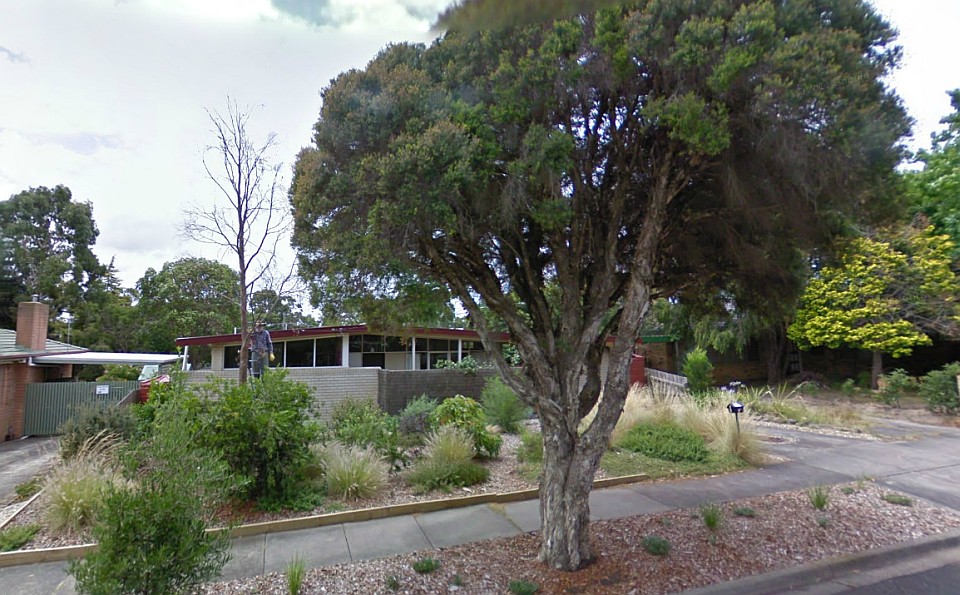
Here's a photo taken in 2010 of our front yard.  Apart from the fact that everything has grown unbelievably in twelve months, the interesting bit is that the photo shows me up a ladder leaning against the dead blue gum just left of centre.
(click on photo to enlarge)

  The other interesting thing about this photo is that it was taken by the Google street-view camera.  I was up the ladder lopping branches off the bluegum before cutting it down when I saw the camera vehicle drive past.  I thought "I'll be on Google street-view one day!"
Here's a view from in front of the house - it's a bit clearer/closer.

 
  Last year, Google ran into trouble for supposedly mapping people's wifi connections, and I thought they had pulled out of updating street-view in Australia, but apparently this has been resolved and I learnt today that the update has been done in the last few months. 
  And there I am.  You can see for yourself on Google maps by looking up Derna Crescent and going into street-view.  lol!


Monday, 15 August 2011

Chooks!

The last fortnight I've been designing and building a chook shed and yard.  The shed for three hens is to be contained in a birdmesh cube roughly 2.7 metres square and 1.9 metres high.  This is complete except for the top of the cube, as seen in this picture:
(click to enlarge)

I had a deadline to finish this last weekend and pickup the hens from Cranbourne.  The shed was ready.  The three Isa Brown hens settled in well.  This cube will be fully proofed on top and the bottom edges against birds and cats and foxes if they come.  The top of the nestbox is hinged to retrieve eggs.  The whole caboodle is made from recycled fencing except for the posts which are new.

The tall gate is made in two halves so that only the top need be opened to throw in green feed or scraps.  The nest box was an instant success.  We got two eggs yesterday, the first full day in the yard, and they found the nestbox without any prompting.  The hens are supposedly POL pullets aged 24 weeks, but I suspect two are a bit older, which is fine with them laying straight away.


Here a hen exits the shed after laying an egg.  The whole front wall panel from whence she emerges is removable for easy cleaning and collection of manure.  The small gate closest to camera will allow access to the rest of the yard when it is complete.

Two of the hens looking for water in the temporary container which they have filled with leaf mulch.  They seem very content and very busy scratching in the mulch for bugs.

Wednesday, 20 July 2011

Our Backyard

  Most of our backyard has been taken up with fruit trees, vegetable beds and herbs.  However, at the back fence an area roughly 10 metres by 3 metres has been occupied by what I would describe as a woody shrub gone berserk.  It was about 7 metres tall!  As the thin branches near the ground fell over they would take root and expand the whole thing.  I had a path on the lower side of the bottom vegetable bed, but the growth caused by rain for the last six months has made the path inaccessible.
  We eventually realised that pruning the growth would be a huge job, and would come back to haunt us every year from now on, and therefore the whole lot should be removed and better use made of the thirty square metres.
  This is what it looked like:                     (click to enlarge)


  You can see a "cave" behind the bare plum tree which is silhouetted in its darkness.  I cut this out to see where the back fence was and determine if a couple of family working bees could handle the whole job.  There was no back fence!  It had been destroyed by the growth!  The amount of mulching would be far beyond what my little electric mulcher could handle in six months.  We therefore rang around to get quotes, consulted the neighbours, and organised for the "Tree Musketeers" (there were four of them) to do the job.
  When they finished the view was still similar because they only cleared to the fence line and much of the growth was in the neighbour's yard.  The neighbour, Lee, is in a nursing home after breaking her hip and the house is empty, but Doortje negotiated with her carer and Lee agreed to get her portion of the growth removed, and we would organise the new fence.
  Once the growth was removed (to "ground level"), we still had to have a working bee to grub out the stumps along the fence line to keep the fencer happy.

It now looks like this:                                (click to enlarge)


  To compare photos, the olive tree on the left and the lemon tree on the far right are visible in both photos.  The piles of rubbish are the result of herculean effort by Daniel, Monika, Helmy and Perran.  The whole yard up to the bottom of the deck has been in shadow during the winter, but is now open to the sun, and although the new fence will cast a shadow, it's certainly a great improvement.
  The plan now is to build a chook yard in the available space, which will mean no/low maintenance for the area, fresh eggs, and manure for the compost bins.
  I'll update this post as the work progresses.

Update 15/8/11

The back fence is built and the chookyard is nearly complete.  It now looks like this:


The chookyard measures 2.9 metres from front to back - effectively the depth that we gained by removing the old growth.  The lemon tree has now been pruned and has room to grow, and we've added a nectarine tree and an apricot/plum cross in the space between the chookhouse and the olive tree.  This will soon be all chook yard.

Thursday, 9 June 2011

Another Folding Bike

  Another bike story!  I'm now the proud owner of a Strida 5.0 folding bike.  Strida was designed in 1985 by Mark Sanders, an English industrial designer.  They have always been far too expensive for what you get, typically $1000 in Australia in the past for earlier models with 12" wheels.  The Strida 5.0, with 16" wheels, now made in Taiwan, is more easily available here for $799.  I've always loved the design.
  This one is a clone, probably made in China, and doesn't have a brand name or serial number, but all components are identical to the Strida 5.0.  I bought it on eBay for $185, a great addition to the collection. (I don't feel too sorry for Mark Sanders - he sold out to Ming Cycles in Taiwan a few years back).

 (click on pictures to enlarge)

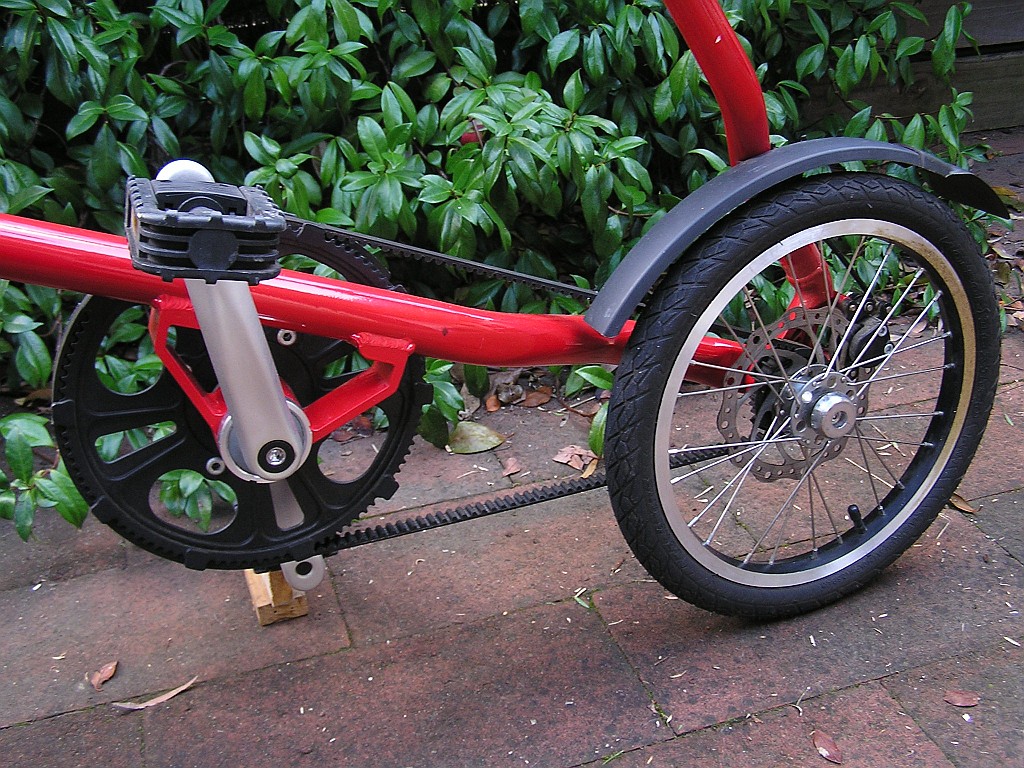
The design innovations include cantilevered wheels (no conventional forks),
disk brakes, belt drive (no greasy chain), with a 7005 aluminium frame, total weight 10kg.
The bottom bar folds up to the seat, the front wheel swings back to overlap the back wheel.


Here you can see the belt and front pulley, the rear disk brake, and the cantilevered wheel.


This shows that it really was built to hold an adult.
The bonus rear rack and mudguards are also visible.


Here it is folded into a neat package that can be wheeled as well as carried.
The pedals and handlebars both fold as well, wheels are "locked" with magnets.


The folded bike in the wheeling position, easy to put on a bus or train.

I don't know if we'd take this bike on a bush track like we have with the black Dahons, but it will be useful when we need a third folder for someone.  Either that or we could hang it on the wall as an ornament, testament to the design ingenuity (just kidding).

Thursday, 19 May 2011

Old Newspapers

I'm a sucker for old newspapers, and while they may give a particular view of history, at least you can see what people were reading at the time.  I've just discovered the National Library online newspaper archive.  You can find it here: http://trove.nla.gov.au/newspaper.
The Adelaide Advertiser is there from 1889 to 1954 and you can download complete newspapers in pdf format. 
Among other things I discovered, none of us boys got a birth notice until Alan (unless I didn't look thoroughly enough) and he obviously didn't have a name when the notice went in:
 (click photos to enlarge)


I can prove I am not a baby boomer but was born while the battle for the Rhine was on:


On the day Pete was born, the Advertiser ran two stories on the front page about Communists, as well as an aerial photo of Port Adelaide wharves, due for some upgrades:


I also checked out the Centralian Advocate, Alice Springs' paper for a long time.  In 1952, it was published weekly, and the Feb 22 issue reminded readers that Al's birthday was the 10th anniversary of the bombing of Darwin (although Alan didn't get a mention!).  Also, the Finke Races were coming up and Bob Smith of New Crown station was the club's president (we knew Bob when we were in Finke in 1973 - he was probably still president):


Anyway, all very interesting, and much more accessible that the microfiche files in the State Library in Adelaide, where I last looked at old newspapers.

Road Rules

This post is entirely for my own interest - and ongoing as I think of things to add.  Any help would be appreciated.


21st Century Road Rules
(as amended to suit current conditions)

1.  Merging onto a freeway requires the expectation that cars already on the freeway will get out of the way.
2.  Texting and/or phone use are mandatory in all situations.
3.  All vehicles on a freeway should travel at the same speed; in particular, vehicles in the overtaking lanes should take care not to overtake anything.
4.  Vehicles turning left into a carriageway should wait until there is oncoming traffic on the right before making the turn.
5.  Drivers entering a freeway should immediately cross into the middle lane;  using the left-side lane is not acceptable.
6.  With traffic lights, a yellow caution light is always a signal to accelerate.
7.  Drivers should take care to always stop at a roundabout, especially if it is deserted.  Alternatively, drivers can speed through without looking left or right.
8.  Drivers turning left should never give way to pedestrians;  drivers should never give way to anything unless they might otherwise die - even then giving way is still not recommended.
9.  Speed limit signs mean slow to the speed of the vehicle in front, unless there is an opportunity to overtake.
10.  Drivers should accept that there is nothing that need slow or impede their progress, in particular double lines painted on the roadway, or school crossings.
11.  If drivers choose to use turn indicators, they should wait until actually making the turn before doing so.  As a general rule, brake lights should always come on before turn indicators.